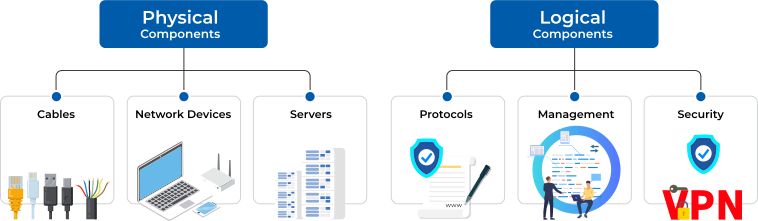
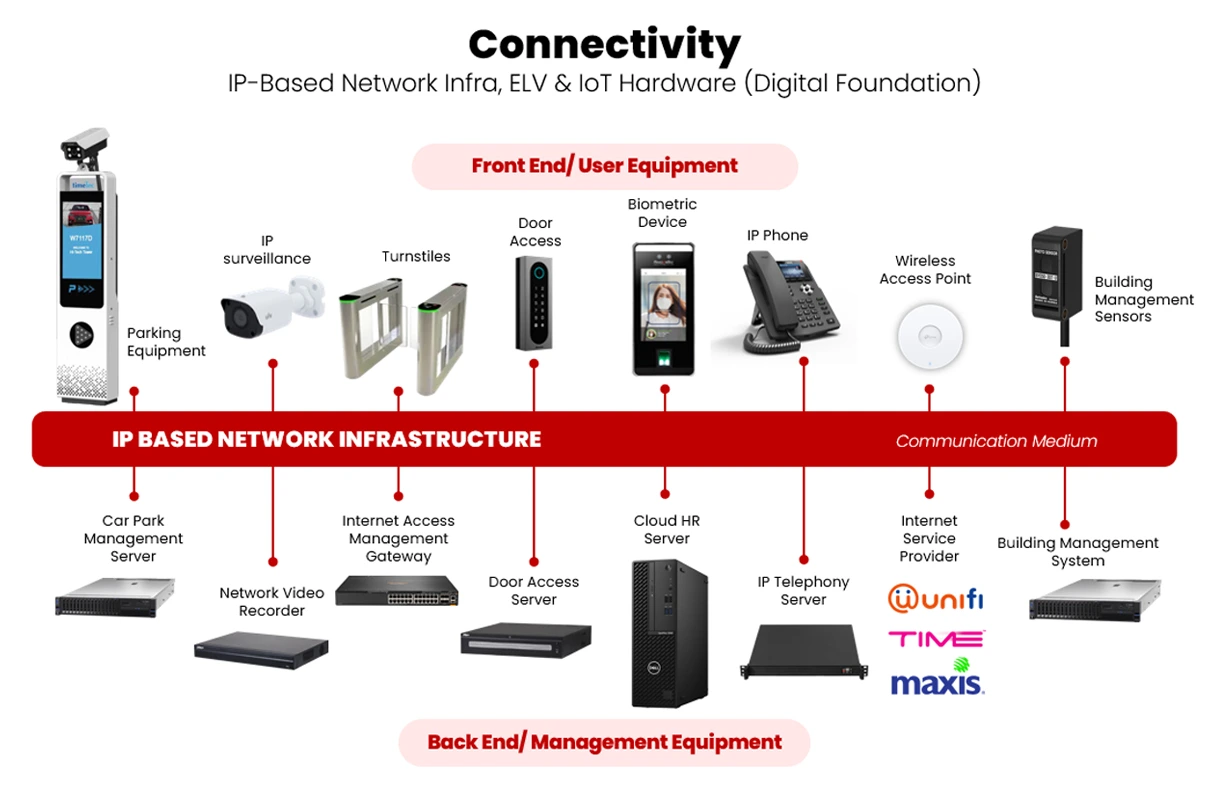
TimeTec offers complete Network Infrastructure solutions alongside our comprehensive PropTech ecosystem, delivering seamless connectivity to support smart building operations. From structured cabling to high-performance network equipment, our infrastructure services are designed to integrate flawlessly with TimeTec’s PropTech solutions—including smart access and elevator control, ELV & IoT automation, smart cashless and touchless parking, visitor management and etc., ensuring a reliable, scalable, and future-ready environment for modern commercial and residential buildings.
What Is a Well-Designed Network Infrastructure?
A well-designed network infrastructure is essential for any organization that relies on technology to operate effectively. It provides the foundation for integrating emerging technologies and new applications, allowing businesses to remain agile, up-to-date, and competitive in their industries.
For service providers, building a robust network infrastructure means ensuring scalability, high availability, and intelligent load balancing. These elements are critical to maintaining seamless connectivity and reliable system performance—key factors in today’s fast-paced digital environment.
Since network interruptions can never be entirely avoided, it's also vital to adopt streamlined network architectures and automated management tools. These help network administrators quickly identify, isolate, and resolve issues, minimizing downtime and ensuring optimal network functionality.
The "Introduction to Analog and Digital Communications" by Simon Haykin - Solution Manual is a valuable resource for students and instructors. It provides comprehensive and detailed solutions to all problems and exercises in the textbook, making it an excellent study aid. While it should not be used as a substitute for original thinking, it is an essential tool for anyone studying analog and digital communications.
The "Introduction to Analog and Digital Communications" by Simon Haykin is a comprehensive textbook that provides an in-depth introduction to the fundamental concepts of analog and digital communication systems. The solution manual for this textbook is a valuable resource for students and instructors, offering detailed solutions to the problems and exercises presented in the main text.
The solution manual for "Introduction to Analog and Digital Communications" is well-organized and structured to mirror the main textbook. The manual is divided into chapters, each corresponding to a specific topic in the textbook, such as signals and systems, Fourier analysis, amplitude modulation, and digital communication systems. The solutions are presented in a clear and concise manner, making it easy for students to follow and understand.
Introduction To Analog And Digital Communications Haykin Solution Manual Apr 2026
The "Introduction to Analog and Digital Communications" by Simon Haykin - Solution Manual is a valuable resource for students and instructors. It provides comprehensive and detailed solutions to all problems and exercises in the textbook, making it an excellent study aid. While it should not be used as a substitute for original thinking, it is an essential tool for anyone studying analog and digital communications.
The "Introduction to Analog and Digital Communications" by Simon Haykin is a comprehensive textbook that provides an in-depth introduction to the fundamental concepts of analog and digital communication systems. The solution manual for this textbook is a valuable resource for students and instructors, offering detailed solutions to the problems and exercises presented in the main text. The "Introduction to Analog and Digital Communications" by
The solution manual for "Introduction to Analog and Digital Communications" is well-organized and structured to mirror the main textbook. The manual is divided into chapters, each corresponding to a specific topic in the textbook, such as signals and systems, Fourier analysis, amplitude modulation, and digital communication systems. The solutions are presented in a clear and concise manner, making it easy for students to follow and understand. The manual is divided into chapters, each corresponding